
REVIEW · SWAKOPMUND OLD TOWN & COAST WALKS
City Tour of Historical Swakopmund
Six stops, one clear picture of Swakopmund. This 2-hour Historical Swakopmund city tour is a focused look at the German colonial town center, starting at the Swakopmund Museum and working through landmark buildings that still shape how the place feels today. I especially like the way the guide, Hans-Dieter Göthje (Kallisto Tours & Services), connects architecture to how people lived, worked, and organized community life back then.
I also love the practical pacing. Each stop gets a real chunk of time, from 15 minutes at the jetty and Hohenzollernhaus to 30 minutes at the Woermannhaus, so you can actually read details on facades instead of sprinting through photos. Plus, admission is listed as free for the stops on the walk.
One thing to consider: the whole tour is short, about 2 hours, so if you want to spend a long time inside buildings or linger on one favorite structure, you’ll likely want to add extra time on your own afterward.
In This Review
- Key highlights on this Swakopmund historical walk
- Why Swakopmund’s German Colonial vibe still hits hard
- Price and value: $37.16 for six landmark stories
- Start at the Swakopmund Museum and meet Hans-Dieter
- Stop 1: Woermannhaus in Bismarck Street, Fachwerk power
- Stop 2: Swakopmund iron Jetty, 1912 engineering under pressure
- Stop 3: Prinzessin-Rupprecht-Heim, a military hospital turned civic care
- Stop 4: Hohenzollernhaus, Hotel details that look built to last
- Stop 5: German Evangelical Lutheran Church and Pastor Vedder’s folded sermon tale
- Stop 6: Marine Memorial, Panther gunboat to national monument
- What the 2-hour pacing feels like in real life
- Who should book this tour (and who might skip it)
- Should you book City Tour of Historical Swakopmund?
- FAQ
- How long is the City Tour of Historical Swakopmund?
- What is the price per person?
- Where does the tour start?
- Does the tour include pickup?
- Is it a walking tour?
- How many stops are included?
- Is admission free for the stops?
- What ticket format do I need?
- What group size is allowed?
- When will I receive booking confirmation?
Key highlights on this Swakopmund historical walk
- German colonial architecture, explained in plain language at major monuments like the Woermannhaus and Hohenzollernhaus
- Six structured stops with time to look closely, not just pass by on a bus
- Port and ocean history through the Swakopmund iron Jetty and the Marine Memorial
- Human stories behind the buildings, including the Red Cross and a very practical church-building origin tale
- Small-group feel with a maximum of 25 people
Other walks through old Swakopmund and along the front
Why Swakopmund’s German Colonial vibe still hits hard
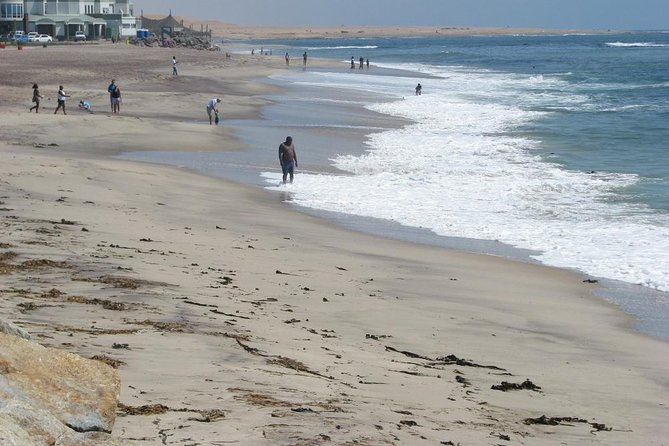
Swakopmund can feel like Namibia’s German seaside twin, and this tour helps you understand why. The town was founded in August 1892 by the German Colonial Reich, and for years it served as the territory’s main harbor, with the mole and later the jetty keeping goods moving.
What I like about walking this part of town is that you are not just seeing old buildings, you are seeing the evidence of how a trading port became a permanent community. The architecture is not decoration for decoration’s sake. It reflects who had money, who built for business, and who organized worship, healthcare, and public memory.
Price and value: $37.16 for six landmark stories
At $37.16 per person for roughly 2 hours, this is the kind of tour that makes sense for a first day. You are paying for a guide to do two big jobs: connect the dots between buildings and give you context fast.
Here’s the value math that matters. You get six named stops across the historical core, and the listed admission for each stop is free. So you are not paying extra as you go, and you do not lose time hunting for tickets or deciding what’s worth it.
The group size is capped at 25, which is a sweet spot. Big enough that it feels efficient, small enough that you can still ask questions and get answers that actually fit your stop.
Start at the Swakopmund Museum and meet Hans-Dieter
The tour begins back at the Swakopmund Museum on Strand Street, at the location noted as 8GFF+Q62. If you like clear first steps, this helps, because you start in the area where the town’s story is easiest to frame.
You’re also offered pickup, which is useful in Swakopmund, where the historical center is walkable but distances can add up if you are juggling beach time. Either way, you finish back at the meeting point, so you do not get stranded halfway across town with a question mark.
And yes, the guide matters here. The reviews repeatedly mention Hans having a deep, personal connection to the place. That shows in the delivery: less lecture tone, more “here’s why that building looks the way it does.”
- Walvis Bay: Marine Big 5 Luxury Catamaran Tour
★ 4.8 · 1,012 reviews - Swakopmund: Desert Dunes Quad Biking with Optional Sandboard
★ 4.9 · 590 reviews - Walvis Bay and Sandwich Harbour Tour
★ 4.8 · 483 reviews - Scenic Sandwich Harbour Tour
★ 5.0 · 277 reviews - Sandwich Harbour Adventure: Seals and Sandwich harbour dune drive
★ 5.0 · 165 reviews
Stop 1: Woermannhaus in Bismarck Street, Fachwerk power
Woermannhaus is your first big “stop and look” moment, located on Bismarck Street. This building is a standout example of Friedrich Höft’s Fachwerkbau style, a half-timber look that reads clearly even from the sidewalk.
What makes this stop feel worth the time is the backstory. The building was erected in 1894 by the Damara and Namaqua Trading company. It was later extended in 1903 and 1904 when wood-paneled offices were added, which is a detail you can actually imagine once you notice the way the structure is organized.
The courtyard detail is one I kept thinking about after the tour: it used to be filled with an evergreen garden. That’s not just trivia. It signals that even in a port town, the trading company wasn’t only about ships and ledgers. People needed workspaces, offices, and a sense of order.
You also learn why the building mattered. It served as the headquarters for the leading trading company in what was then South West Africa, later known as Woermann, Brock & Co. A tower detail ties it to navigation too, since the Damara Tower in the north-west corner acted as a lofty lookout, also serving as a flag mast and navigation point.
Practical takeaway for you: when you’re standing here, spend a minute scanning for how the tower placement and facade details communicate importance. This is a building that was meant to be recognized.
Stop 2: Swakopmund iron Jetty, 1912 engineering under pressure
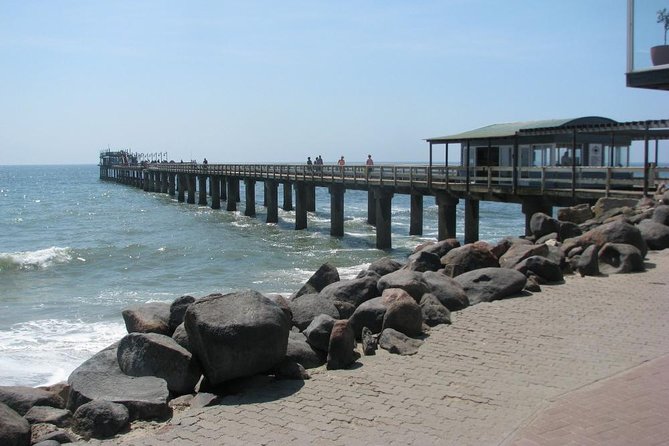
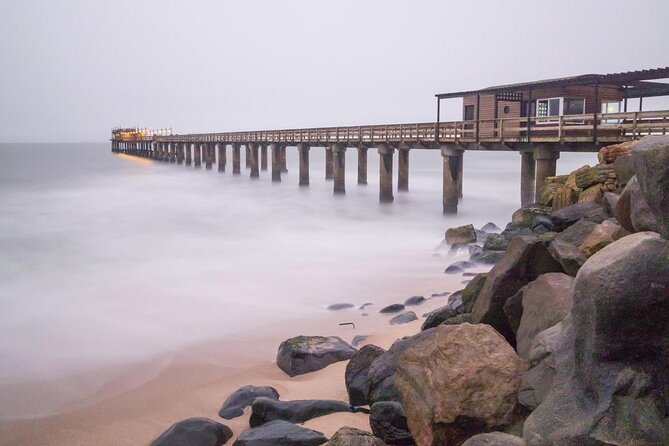
Next comes the Swakopmund iron Jetty, constructed in 1912. This was built to replace an earlier wooden jetty that had become derelict, so you can already sense the theme: maintenance, upgrades, and coping with harsh conditions.
The plan was ambitious, aiming for a 640-meter jetty length. Rocky conditions made construction difficult, and the builders developed a drilling program to overcome those obstacles. That’s the kind of story that makes the final result feel earned, not just historic.
Then reality shows up. When the First World War broke out, the jetty was left uncompleted and ended up at 262 meters. But here’s why this stop earns its place in the tour: the jetty was built to high standards and survived the Atlantic pounding for over 70 years with little or no repair.
You do not need to be an engineer to appreciate what you’re seeing. You just need to remember that this is an ocean-front structure that was designed for long-term strain.
Time check: you get about 15 minutes here. Use it to look along the structure line and imagine the work behind it, especially if you’re the type who likes turning photo moments into story moments.
Stop 3: Prinzessin-Rupprecht-Heim, a military hospital turned civic care
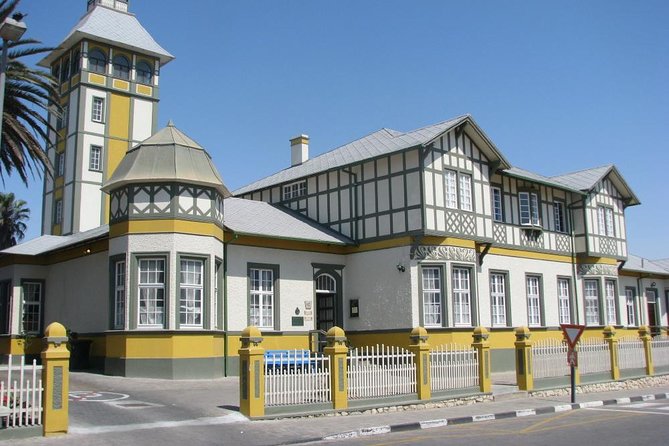
The Prinzessin-Rupprecht-Heim stop is a different kind of story, one that shifts from commerce and harbor functions to healthcare and community care. Built in 1902, it was named after the patroness of the Bavarian Association and the wife of the heir to the Bavarian throne, Prinzessin Rupprecht.
Originally, it functioned as a military hospital and was occupied in 1902. In 1909 the hospital closed, and the building was converted into a convalescent home in 1911. Then the Bavarian Women’s Association of the Red Cross took over, commissioning extensive renovations with a donation of 35,000 mark.
This is the stop where the tour helps you see the social side of colonization, not just the economic and architectural side. People needed medical care, recovery spaces, and organized help. Even the naming gives you a window into who had influence and which organizations carried authority.
A small consideration: you get about 20 minutes at this stop, so you’ll want to focus on reading the building’s role rather than hunting for every tiny detail. If this kind of human history matters to you, this is often the most satisfying stop.
Stop 4: Hohenzollernhaus, Hotel details that look built to last
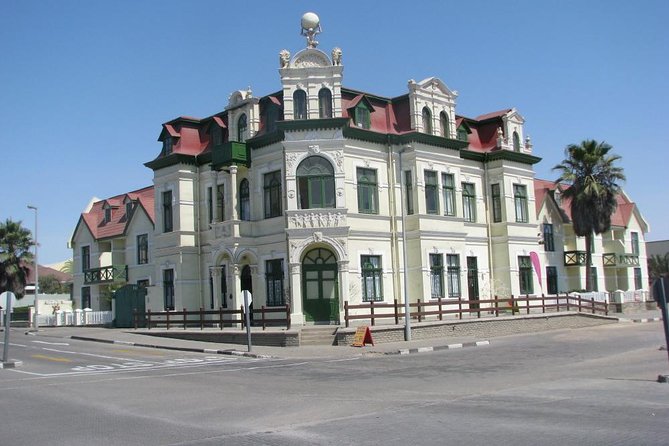
Haus Hohenzollern, better known as Hohenzollernhaus, is where Swakopmund’s German architecture gets theatrical. The building was constructed between 1904 and 1906, and it’s described as one of the town’s most extraordinary structures.
Look at the decorative features mentioned in the tour details. You’ll see cupid and flower adornments, a corner pediment edged off with two lions, and an imperial image of Atlas with the world on his shoulders. Yes, it’s dramatic. That’s the point. In places like this, ornament was a way to communicate power and pride.
The best part of this stop is the contrast. The Namib Desert is harsh, yet the pioneers managed to construct buildings with enduring beauty. This is a reminder that “survival” and “style” can both exist in the same place.
Time here is about 15 minutes. That’s short, but it’s enough to appreciate the facade and the way the building looms over nearby structures. Stand back for a full view first, then move in for details once you understand the overall massing.
Stop 5: German Evangelical Lutheran Church and Pastor Vedder’s folded sermon tale
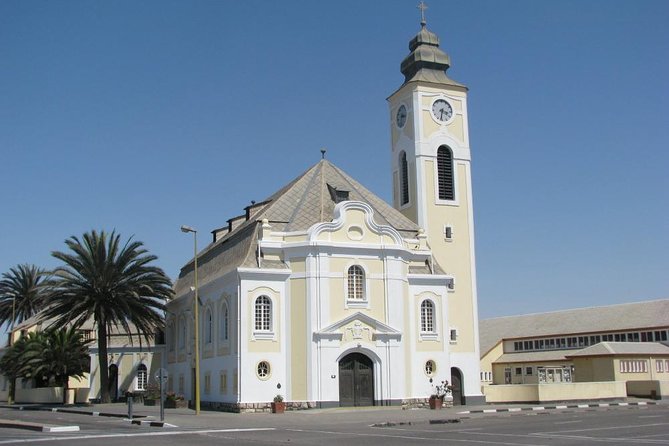
The German Evangelical Lutheran Church, along with its adjacent parsonage, brings in religious and community life. The story you hear around this stop adds humor in a very human way.
There’s a rumor that in 1905 Pastor Vedder showed up for open-air church services and found them completely unattended. He supposedly went home to a wooden crate without roof, doors, or windows, and returned with his sermon still neatly folded and unread.
By 1909, the congregation rallied together for building plans, and Architect Ertl designed a magnificent house of worship in the neo-Baroque style. The building contract went to F. H. Schmidt in 1910, for a stated amount of 85,000 Mark. Bells were cast by Franz Schilling in Apolda, Germany.
What you should take from this stop is that religious life was not just imported ritual. It was shaped by local realities, then solidified into physical structures once people had the backing to make it work.
Time check: you get about 20 minutes here. If bells and worship details matter to you, give yourself a full moment at the entrance area, then look for how the parsonage sits with the church. The pair helps you see the community layout, not just the one standout building.
Stop 6: Marine Memorial, Panther gunboat to national monument
The Marine Memorial is a powerful closer to the walk. It’s dedicated to members of Germany’s First Marine Expedition who were killed in action.
The statue depicts a marine standing beside his fallen comrade. The tour notes that it was designed by Berlin sculptor A. M. Wolff and cast by Gladenbeck A. G., also in Berlin. This is where you start to feel how the town’s identity was tied to naval action and public remembrance.
One detail I like because it connects coast to community: the crew of the gunboat Panther presented the monument to the town of Swakopmund on behalf of the Marine Infantry on 26 July 1908. Then, decades later, the National Monuments Commission declared the Marine Denkmal a National Monument on 2 January 1969.
You get about 20 minutes at this stop, which is just enough to absorb the symbolism and read the naming behind the memorial. If you’re sensitive to war memorials, take your time without rushing. It’s one of those places where the facts are the story.
What the 2-hour pacing feels like in real life
This is a short tour, around 2 hours total, so you should treat it like a “get your bearings plus learn fast” experience. The stops are spaced so you can walk between points in the historical core and still get real attention at each building.
A practical way to enjoy it more: pick one or two stops you want to remember most. For some people it’s Woermannhaus and its trading power. For others it’s the jetty because the ocean history is easy to visualize. If you try to care equally about all six, you can, but you might end the tour with less of a “favorite” feeling.
Also, you’ll be outside for most of it. Bring a hat and water, and dress for cool wind because Swakopmund can shift quickly.
Who should book this tour (and who might skip it)
You should book if you want:
- German colonial architecture with context, not just a photo walk
- A structured way to understand why Swakopmund looks the way it does
- A guide-led route with free access at each stop
- A quick first-day overview in a compact 2-hour window
You might skip if:
- You already know the buildings deeply and want more time per stop
- You want a tour that focuses on beaches or museums rather than walking the historical core
Should you book City Tour of Historical Swakopmund?
If you’re in Swakopmund for even a short stay, I think this is a strong buy. The price is fair for six major stops, and the “free admission” aspect means you’re paying for the storytelling more than for entry fees.
Most importantly, this tour is guided by a person who clearly cares about how the town works, historically and culturally. If your goal is to walk away with a mental map of Swakopmund, plus details you can share later, this fits that job very well.
If you can only pick one structured activity for your first day in town, make it this one. Then you can return later on your own to the building you liked most.
FAQ
How long is the City Tour of Historical Swakopmund?
It’s approximately 2 hours.
What is the price per person?
The price is $37.16 per person.
Where does the tour start?
The tour starts at Swakopmund Museum on Strand Street (8GFF+Q62).
Does the tour include pickup?
Yes, pickup is offered.
Is it a walking tour?
It concentrates on the historical part of Swakopmund and is described as a walking tour.
How many stops are included?
There are six stops: Woermannhaus, Swakopmund Jetty, Prinzessin-Rupprecht-Heim, Hohenzollernhaus, the German Evangelical Lutheran Church, and the Marine Memorial.
Is admission free for the stops?
Admission ticket information is listed as free for each of the stops.
What ticket format do I need?
You get a mobile ticket.
What group size is allowed?
The tour has a maximum of 25 travelers.
When will I receive booking confirmation?
Confirmation is received at the time of booking.
More Trips Across Namibia
- Walvis Bay: Marine Big 5 Luxury Catamaran Tour★ 4.8 · 1,012 reviews
- Walvis Bay and Sandwich Harbour Tour★ 4.8 · 483 reviews
- Scenic Sandwich Harbour Tour★ 5.0 · 277 reviews
- Scenic Desert Tour by Bike★ 5.0 · 165 reviews
- Living Desert Eco Dune Tour★ 5.0 · 113 reviews
More Namibia Reviews
- Walvis Bay: Marine Big 5 Luxury Catamaran Tour★ 4.8 · 1,012 reviews
- Swakopmund: Desert Dunes Quad Biking with Optional Sandboard★ 4.9 · 590 reviews
- Walvis Bay and Sandwich Harbour Tour★ 4.8 · 483 reviews
- Scenic Sandwich Harbour Tour★ 5.0 · 277 reviews
- Sandwich Harbour Adventure: Seals and Sandwich harbour dune drive★ 5.0 · 165 reviews
Old Swakopmund on Foot
- swakopmund city tour dune 7 pink lake pink flamingos★ 3.8 · 39 reviews
- Walvisbay Dune 7 and Swakopmund Town Half Day Guided Tour★ 4.0 · 4 reviews
- Cultural Tour in Swakopmund★ 5.0 · 3 reviews
Other Namibia trips from our own write-ups


Swakopmund Old Town & Coast Walks, all of them.
 ★ 3.8swakopmund city tour dune 7 pink lake pink flamingosFrom $7539 reviews
 ★ 4.0Private Half Day Coast Tour of Walvis Bay and Swakopmund CityFrom $2016 reviews
 ★ 4.0Walvisbay Dune 7 and Swakopmund Town Half Day Guided TourFrom $04 reviews
 ★ 5.0Cultural Tour in SwakopmundFrom $1053 reviews
This tour also turns up in